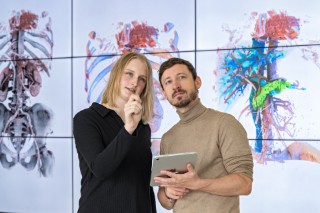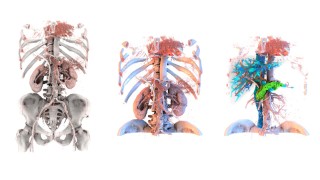
With the gammaSTAR software platform and the SpinIt project, researchers at the Fraunhofer Institute for Digital Medicine MEVIS are facilitating the transfer of innovative imaging technologies into routine clinical use.
more info
With the gammaSTAR software platform and the SpinIt project, researchers at the Fraunhofer Institute for Digital Medicine MEVIS are facilitating the transfer of innovative imaging technologies into routine clinical use.
more infoThe spin-off Plain Medical has emerged from the long-standing collaboration between the Fraunhofer Institute for Digital Medicine MEVIS and the Radboud University Medical Center (UMC). Based in Nijmegen, the Netherlands, the company began operations in the summer of 2025. Its mission is to accelerate routine radiological tasks through intelligent automation and to pave the way for a new generation of AI-driven diagnostics. In doing so, it aims to address the growing shortage of radiology professionals in Europe and to relieve the burden on clinical staff.
more info
Fraunhofer MEVIS celebrates its anniversary — and shows how new technologies can improve healthcare. Founded in 1995 as an interdisciplinary research center in Bremen, the Fraun-hofer Institute for Digital Medicine MEVIS has since become one of the world’s leading institutes in its field. The institute is celebrating its 30th anniversary with several events: On the evening of September 3 a festive ceremony will take place in Bremen’s historic town hall, where representatives from politics, business, and science will reflect on the institute’s success story and also explore its future outlook. On September 4 international experts will gather at the institute for a symposium on future developments in medicine, focusing on the role of Artificial Intelligence (AI) in cancer care. In the afternoon Fraunhofer MEVIS will then welcome the public and offer interactive insights into ongoing research during an Open House.
more info
A research consortium led by University Hospital Erlangen and Charité – Universitätsmedizin Berlin has, for the first time, systematically acquired and analyzed MRI scans of the uterus in both healthy and diseased states as part of the RACOON FADEN project. The image data were evaluated using CuraMate, a modular software platform developed by the Fraunhofer Institute for Digital Medicine MEVIS for the annotation, segmentation, and quantification of medical image features.
more info
Regular follow-up monitoring is crucial when it comes to treating cancer successfully. In the SPIRABENE project, Fraunhofer Institute for Digital Medicine MEVIS developed a deep learning-based software program which makes it possible to identify disease- and treatment-related changes in tumors in CT images with even greater speed and accuracy, thus improving the chances of recovery and making day-to-day clinical practice easier.
more info
In the 2025/26 school year, the new upper secondary specialization called “Digital Medicine” will launch in Bremen, developed by Fraunhofer MEVIS and the Oberschule am Waller Ring. On January 23 and 24, interested students can learn more about the new offering in the school auditorium at Lange Reihe 81 in Bremen.
more info
Researchers from the Fraunhofer Institute for Digital Medicine MEVIS will present the latest technologies aimed at optimizing clinical workflows and improving patient care at the annual meeting of the Radiological Society of North America (RSNA 2024), held from December 1 to 5 in Chicago.
more info
Researchers from the Fraunhofer Institute for Digital Medicine MEVIS, the University Medical Center Freiburg, and Stryker Leibinger GmbH & Co. KG have been awarded the Research Prize for Digitalization in Orthopedics and Trauma Surgery 2024 for their publication entitled “Validation of a Finite Element Simulation for Predicting Individual Knee Joint Kinematics.” The award ceremony took place on October 25, 2024, during the German Congress for Orthopedics and Trauma Surgery (DKOU 2024) in Berlin.
more info
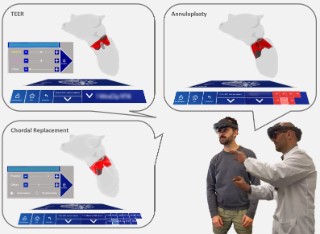
Heart valve reconstruction is a highly complex operation that requires a great deal of expertise from surgeons. On the occasion of World Heart Day on September 29, 2024, the Fraunhofer Institute for Digital Medicine MEVIS will present the MINIMAKI assistance system. Based on artificial intelligence methods, it enables interdisciplinary cardiac teams from surgery, cardiology and anesthesia to plan heart valve procedures quickly and optimally using mixed reality.
more info
The use of Artificial Intelligence (AI) systems shows promise in medicine, where they can be used to detect diseases earlier, improve treatments, and ease staff workloads. But their performance depends on how well the AI is trained. A new multi-task approach to training AI makes it possible to train foundation models quicker and more cost-effectively, with less data. Researchers are turning to this approach to compensate for the shortage of data in medical imaging — and ultimately save lives.
more info